Search this blog

Sunday, September 17, 2017

My Non-British Army of the Rhine

Starting my second Army for Team Yankee, as my Soviets need a NATO opponent, I chose the British Army (again, as with other periods, my anglo-philia breaks through). I first opted for the West Germans, but as I know three other Bundeswehr players already and the Americans are just not competitive at the moment, the Brits it should be.

But having a faible for the non-English parts of the British Isles, especially Ireland, it will be a Non-British Army of the Rhine based around the Irish Guards. And would could resist flying Scotsmen in Lynx Helicopters?
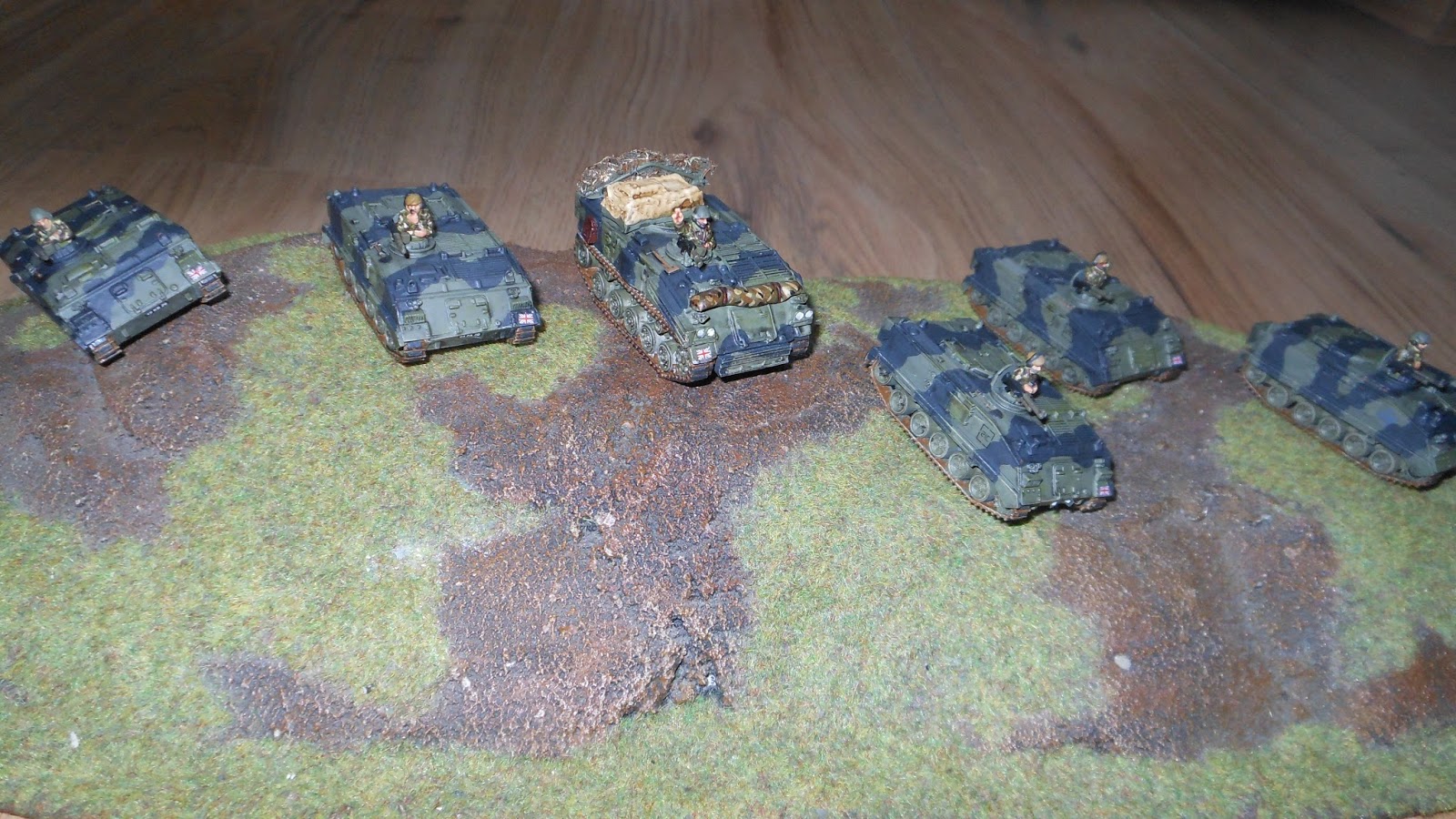
First up are the FV 432s, which will carry the 1st Platoon of the Irish Guards into battle. I really like how the green/black grey camouflage scheme helps the vehicles to blend in with the terrain at a distance. Should work even better when placed in wooded areas of the table.

The models are Battlefront's amazing plastic kit. Although assembly is a bit fiddly, the outcome is pretty nice. You also have the options build Swingfire ATGMs and Mortar Carriers with this kit, so I am sure, that I will have to build at least two more packs of them. But beware, the British decals are not the best quality and tend to tear very easily. 

I placed a tank commander on top of every vehicle, as it is important to me to emphasize, that it is real people, who are fighting, not just metal machines.

I also added a command vehicle with extra radios and stowage made by Armies Army. The model is full resin/metal and has slightly bigger dimensions than its BF cousins, but as it will be fielded as a transport for the company commander, this is alright.

Now, let's turn to the big guns. Although I will mainly focus on infantry with this force, I could not resist to buy some Chieftain MBTs. The BF plastic tanks look awesome and are quite an useful asset in the game. With two AT 22 shots (one when moving) and Front Armour 16 (17 with Stillbrew package) at 6/7 points, they are rather cheap MBTs and a must-have.

Although the Iron Maiden army book portays the chieftains as the 17th/21st Lancers, my guys are from the Royal Irish Hussars, who were part of the same division, and therefore sticking to the non-English theme.
I intend to use them either as integral and divisional support for the Irish Guards or as a small Armoured Company formation on its own, depanding on the scenario.


That's it for now, but there is some more stuff coming up, as I flesh up my Soviets and have also been working on some terrain and my Lion Rampant forces for the Burgundian Wars. So get excited!

Monday, September 4, 2017

A Wargamer's Holiday in Poland

So, after a two month break due to summer holidays and a lot of trouble at the new job, I am back with the blog. Before I return to the usual manner of documenting my painting and gaming progress, now for something completely different...

End of July we made a trip around our beautiful neighbour country, Poland. Here are some impressions, which might be interessing from a wargamer's perspective with a little bit of illustrating commentary. Our first stop was the capital of Warsaw:
The old city walls of Warsaw with bastion. An example of the so-called Brick-Gothic.
The monument in memory of the Warsaw Uprising during WW2 in front of the (at the moment highly debated) Polish Supreme Court. From 1. August to 3. October 1944 the partizan forces of the Polish Home Army rose up against the Nazi occupation forces. Although the Red Army was already waiting(!) on the other bank of the Vistula, the Polish fighters were beaten back and massacred by SS and German security forces.
The monument depicts the retreat of the partizans into the sewers of Warsaw

After two days in the Masurian Lake District and East Prussia, where I saw, why Poland was such excellent cavalry country (lots of flat hills and wide plains, only broken up by some dense woods), we arrived at THE WW2 TOURIST MAGNET in Poland: The Wolfsschanze. This was the HQ of Adolf Hitler and High Command of the German Wehrmacht during the campaigns against Soviet Russia.
WARNING: Visitors beware! The Wolfsschanze l lies deep in a swamp areal with A LOT of HUGE aggressive insects! But we were told, that these are very democratic insects, they sting everyone (except Japanese, who are too fast)!
Some American Reenactors with an old BTR
Flak bunker at the entrance of the Wolfsschanze
Former Officers' mess
Memory plaque of the failed assasination attempt on Hitler by Col. Count Stauffenberg on the 20th of July 1944.
A look inside the destroyed bunkers
The personal bunker of the Führer himself
A cut through the thick bunker walls of steel and concrete. Ironically built by the firm, my father used to work for.

Now the highlight of our trip, a visit of the Marienburg or Malbork. This was the HQ of the Ordensstaat of the Teutonic Order and the biggest fortress made of bricks worldwide. This is the incarnation of the so-called brick-gothic style, because there were not enough rocks in the region, the Teutonic Order built its fortress out of clay bricks.

Here are some thirteenth century reliefs in the main hall of Malbork depicting medieval battle scenes.

Some preserved medieval cannon balls made of stone.
A medieval helmet and shield in the quarters of the Hochmeister
The horses of some Teutonic Order reenactors
The Author on the chair of the Hochmeister of the Teutonic Order 


The final stop of our trip was the free city of Danzig/Gdansk. After some sights of the nightmares of every German Literature teacher (Günther Grass, Buddenbroks, Martin Opitz), we eplored the city for ourselves. Sadly it was raining cats and dogs, so the boat tour to the Westerplatte, the first battle of WW2, could not be made. But we saw the other place, where the first shots of WW2 were fired:
 
Memorial for the defenders of the Danzig Postal Office
Me posing with a giant rifle
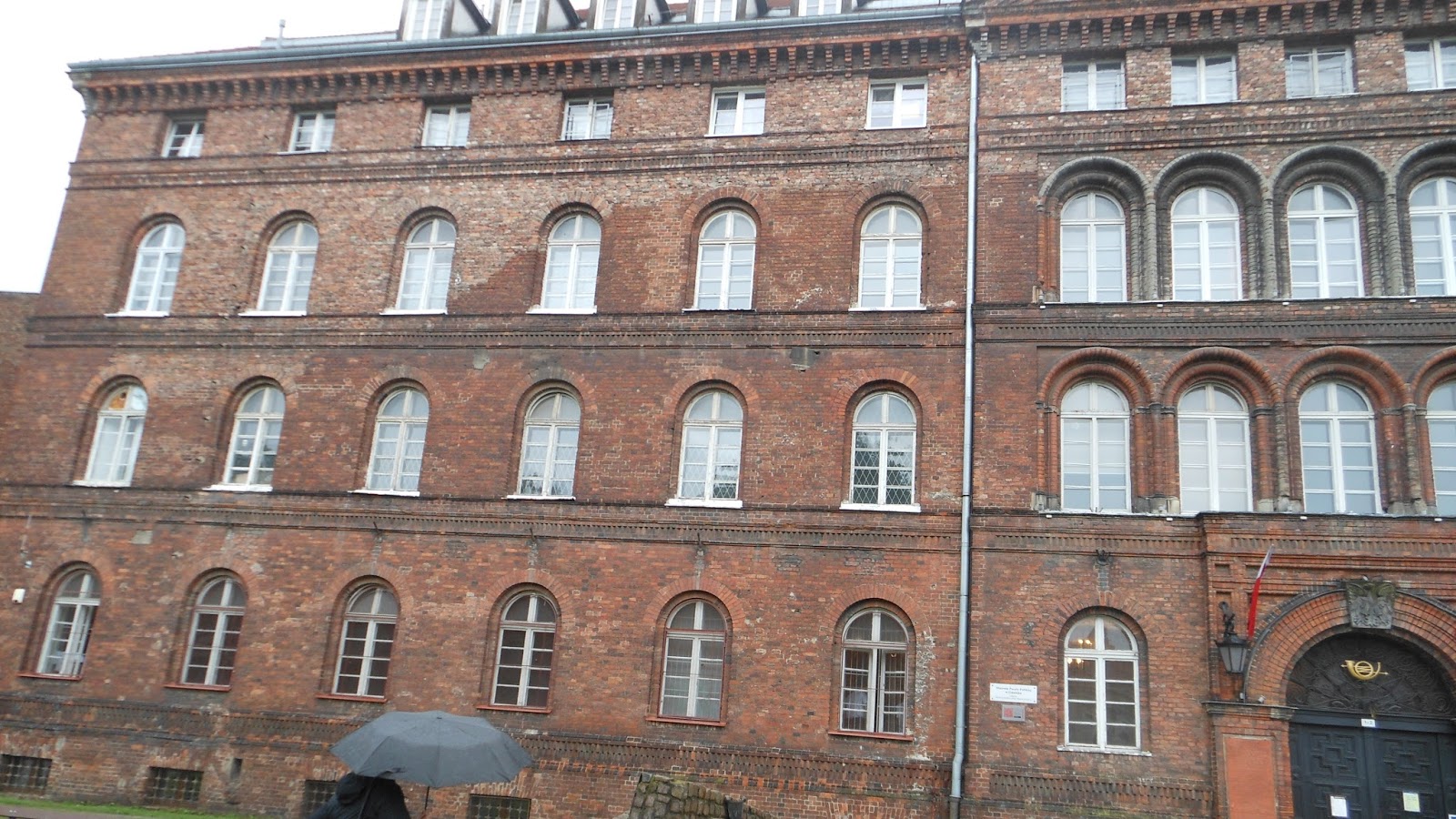
Front view of the Danzig Postal Office
The battle of the Danzig Postal Office of some 50 Polish Militia, lead by Lt. Konrad Guderski, versus elements of the SA and SS Danzig-Heimwehr might be a scenario for me to stage on the tabletop with my Bolt Action Polish Army. The scenario is included in Warlord's "Germany Strikes!" campaign supplement.
The Danzig Museum of World War 2 is indeed a sellout!
The Author in a childrens' T-34 Tank!
After returning from Poland, I sat down at the painting table and had the inspriration to finally finish the last units of my Bolt Action Polish forces, which were waiting for one-and-a-half years. 12 Polish Cavalry Lancers of the 3rd Silesian Uhlans Regiment and a P11c Fighter.

Saturday, July 1, 2017

The British are coming

Or "The Regulars are coming!", like the original alarm cry of Paul Revere, history's most celebrated coward (read Bernard Cornwell's "The Fort!).

Here are some reinforcements for my AWI British forces. I bought these three regiments off ebay, but had to do some heavy retouching to at least closely match my usual painting standard.

First, there is the 4th (King's Own) Royal Regiment of Foot. Raised in Lancaster, It fought at the Battles of Lexington and Concord in April 1775, the Battle of Bunker Hill in June 1775 and the Battle of Long Island in August 1776. It also saw action at the Battle of Fort Washington in November 1776, the Battle of Germantown in October 1777 and the Battle of White Marsh in December 1777.
4th Regiment in full order

Next up, there is the 46th (South Devonshire) Regiment of Foot. The regiment arrived in North Carolina in April 1776. It fought at the Battle of Long Island in August 1776, the Battle of White Plains in October 1776 and the Battle of Fort Washington in November 1776. It saw further action during the Philadelphia campaign at the Battle of Brandywine in September 1777 the Battle of Paoli also in September 1777 and the Battle of Germantown in October 1777. 
It was following the British attack on the Americans at Paoli, where the light company of the regiment took no prisoners and the Americans demanded vengeance, that the regiment decided to insert identifying red feathers in their caps to prevent anyone else suffering on their account: hence the nickname the Red Feathers. The regiment went on to fight at the Battle of Monmouth in June 1778 and operations against New Bedford and Martha's Vineyard in September 1778. It sailed for the West Indies in November 1778 and took part in the attack on Saint Lucia and the Battle of Vigie in December 1778.
The 46th Regiment

Finally, there is the combined battalion of the 2nd Grenadiers, consisting of the grenadier companies of the 37th, 40th, 43rd, 44th, 45th, 46th, 49th, 52nd, 57th, 63rd, and 64th Regiments.

Combined 2nd Grenadiers in marching order


Sunday, June 18, 2017

BUF at Paradeground Drill

To continue with my Very British Civil War collection, I present to you the British Union of Fascists!

As Warlord Games have released their excellent new campaign supplement for Bolt Action: Operation Sea Lion, I finally found some motivation to paint my BUF, wich had been sitting built and primed in a cellar box for quite a while now. 
The first bunch are from Musketeer now Footsore Miniatures:
BUF Group Leader and Flagbearer
My Footsore bundle comprises of one Officer with Colour-Sergeant, a 10-men section with Lewis Gun and Sergeant with SMG, and a HMG squad with a Vickers machine gun as support. These miniatures are really lovely detailed and were fun to paint up. Especially the added surplus Britsh Army equipment, e.g. the webbing gives them a convincing touch. My compliments to the very talented sculptor Paul Hicks.
1st half-section with Lewis Gun
2nd half-section practicing shooting drills in front of the barracks
HMG support squad
Next up is the 2nd section of my British Fascist force. Two officers and 10 riflemen (sadly no Lewis Gun). I am very proud owning these miniatures, as they were painted by Stephen Mortimer aka Mort, one of the creators of VBCW! A very decent guy, with whom I intend to keep contact.
Two BUF Officers shouting commands at the Paradeground
3rd half-section practicing Rifle Drill
I got in contact with him via eBay as he sold some of his stuff and this ended in him painting these up especially for me (although I added the red piping to blend them in with the 1st section). They originally might have been WW1 Belgians, I suppose, but their look and the moustaches really make them work as BUF.
4th half-section advance (take notice of the moustaches!)
To add some mobile support to the operations of the BUF, they mounted a 6-men section on motorcycles with sidecars. These were originally Cthullu Cops, but I bought them off eBay painted as they are now, in BUF Action Uniform.
BUF Motorcycle Patrol
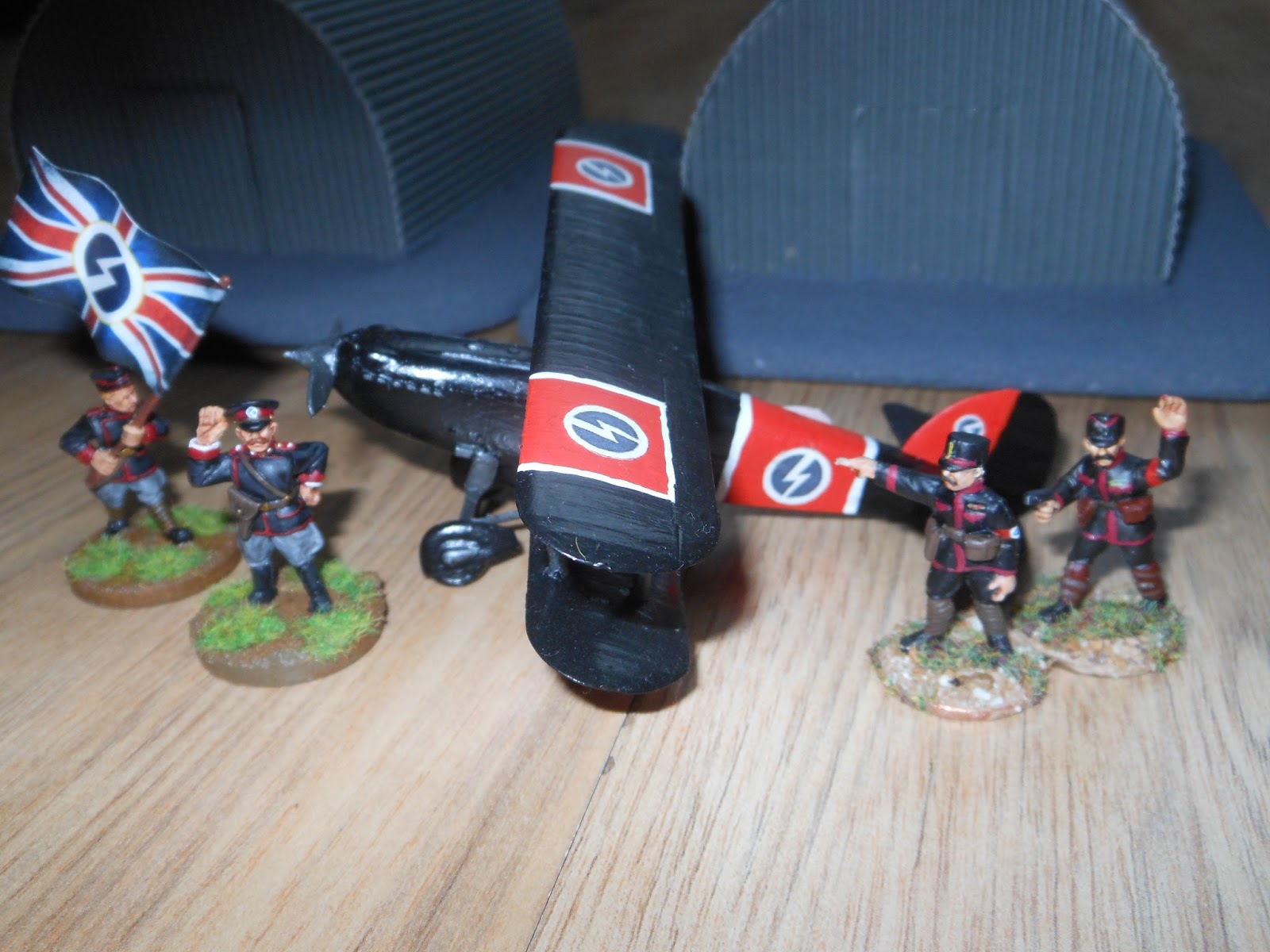
You might have noticed the lightning-like symbol on the flag and motorcyles (it is on every models armband as well!). This is the official symbol used by the BUF, the "Flash of Action" in the "Circle of Unity". Rather anti-fascist minded folk simply called it the "Flash in the Pan"^^.

At last, my British Union of Fascists also have some air support, a venerable Hawker Fury Mk.1 plane, which was painted in the party colours (camouflage seemed not to be an issue here...).
Officers inspecting a BUF Hawker Fury aircraft.
With release of Sea Lion I hope to use them as a Fifth Column in Bolt Action, soon, as well as confronting the IRA, Socialists and Irish Communists in Northern Ireland's VBCW.

To complete this fascist force, I want to add Warlord's new BUF militia, including support weapons, a Lancaster Armoured Car, and the Leader himself: Sir Oswald Mosley with his wife Diana. 

That's it for now, the first steps of my BUF platoon/batallion.